How people choose a $10,000 service in 2026: the new buyer journey
By John Kiama · 10 min read · Last updated
By the time someone fills in your enquiry form, most of the deciding has already happened.
How customers choose a service provider has changed more in three years than in the previous fifteen. They compare you with two or three competitors, read your reviews, and increasingly ask an AI tool for a shortlist, all before you know they exist.
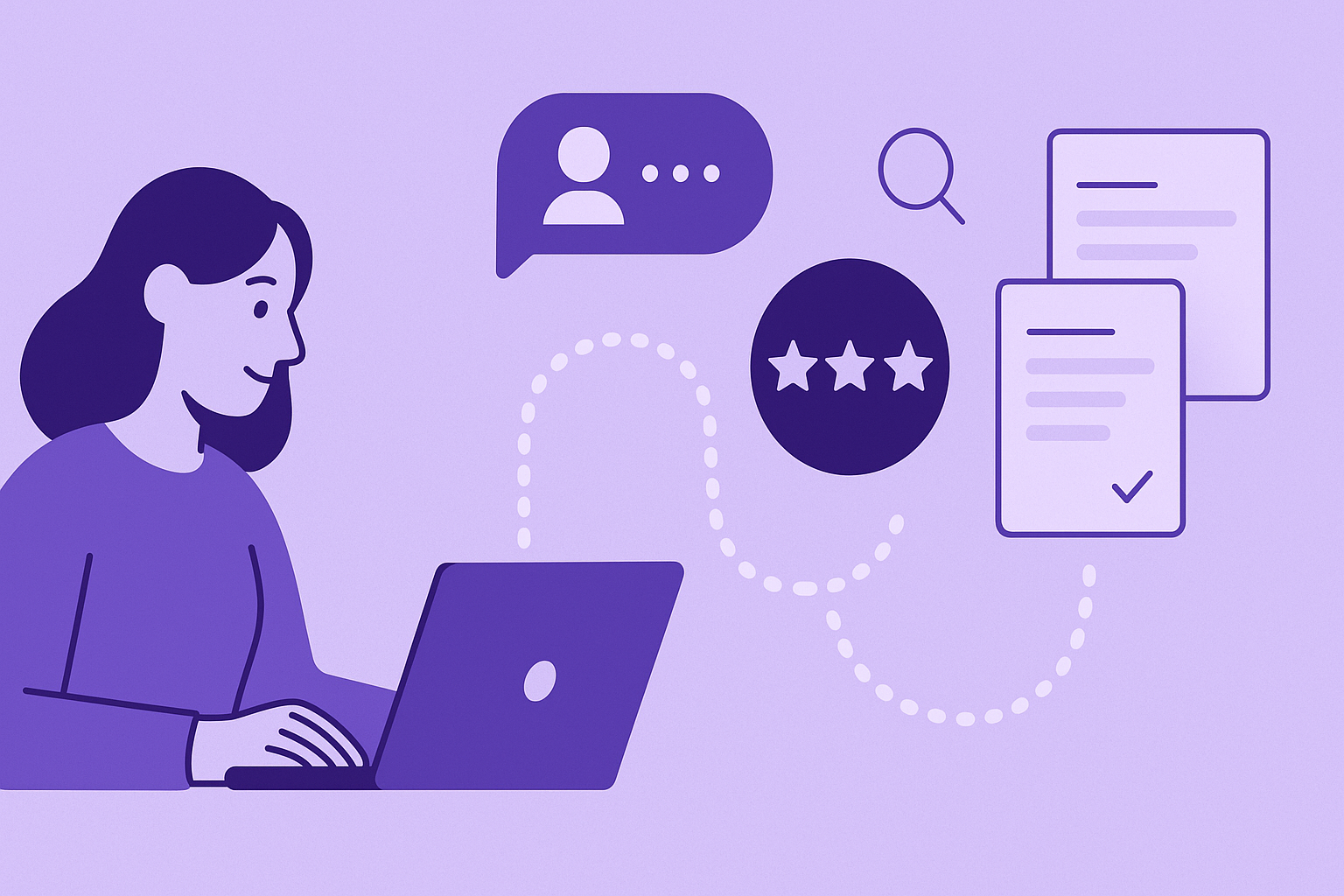
The enquiry is not the start of the journey. It is the end of a long, mostly invisible one. We call it the invisible journey, and it runs in four stages: quiet research, the AI shortlist, the proof check, and the comparison.
By the end of this article you will know:
- What buyers do at each of the four stages, with the evidence.
- The quick checks to run on your own business this week.
- What to fix first. It is rarely more traffic.
The journey your marketing was built for
The old model was simple. Someone realises they need a dentist, a broker, a builder. They search, click an ad, call the business that looks most credible, and book.
Most service websites still assume this:
- The homepage asks for a call before it has earned one.
- Ads send cold traffic straight to a contact form.
- Follow-up assumes anyone who enquires is ready to buy this week.
That model worked when buyers had to talk to you to learn anything. Now they can learn almost everything about you, your prices and your reputation without you knowing they exist.
The invisible journey at a glance
Four stages, each with its own way of losing you the client:
| Stage | What the buyer is doing | Where businesses lose them | Quick check |
|---|---|---|---|
| 1. Quiet research | Searching problems not providers, reading reviews, lurking in groups, visiting your site repeatedly | Publishing nothing that answers the money questions | Does your website answer the ten questions buyers ask you in person? |
| 2. The AI shortlist | Asking ChatGPT, Gemini and Google AI who to consider | Invisible to AI tools: thin reviews, inconsistent listings, no clear specialty | Ask ChatGPT “best [category] in [city]”. Are you in the answer? |
| 3. The proof check | Eliminating options using reviews, responses, photos and case studies | Stale reviews, no responses, generic praise | Is there anything on your profiles recent and specific enough to trust? |
| 4. The comparison | Enquiring with two or three providers at once | Slow, generic or short-lived follow-up | Mystery-shop your own enquiry. How fast and how good was the reply? |
Word of mouth runs underneath all four stages, and you will never see it in a dashboard. More on that below.
Stage 1: quiet research, long before you exist to them
For a purchase worth thousands, people research carefully and slowly. Weeks is normal. Months is common for renovations, cosmetic work and education decisions.
During that time a typical buyer will:
- Search the problem before the provider. “How much does Invisalign cost” comes long before “cosmetic dentist near me”.
- Read reviews everywhere, across Google, social media and industry sites.
- Lurk in local Facebook groups and community forums.
- Visit your website three or four times without contacting you.
- Ask friends who they used, and whether they would use them again.
Almost none of this shows up in your reporting. Which is why so many owners conclude the buyers are not out there. They are. They are just not visible yet. More on that group in the 95% problem.
Do this before you move on:
- Write down the ten questions buyers ask you in person: costs, timeframes, risks, comparisons.
- Check whether your website answers each one honestly. Every gap is a page future buyers cannot find you on.
Stage 2: the AI shortlist, the new gatekeeper
The newest change, and the one most owners underestimate: people now ask AI tools who to consider.
- 45% of consumers have used AI tools such as ChatGPT, Gemini or Perplexity to find local businesses (BrightLocal, 2026 Local Consumer Review Survey).
- Google now answers a growing share of searches with an AI Overview before a single website link appears.
The behaviour looks like this. Someone types “best mortgage broker for first home buyers in Adelaide” into ChatGPT. It returns two or three names, with reasons.
That answer is the shortlist. If you are not in it, you were never in the running, and nobody will tell you it happened.
AI systems recommend businesses that are clearly known for a specific thing in a specific place, backed by reviews, consistent listings and mentions on trusted sources. The mechanics are covered in the guide to getting recommended by ChatGPT and Google AI Overviews.
Do this before you move on:
- Ask ChatGPT and Google: “best [your category] in [your city]”. Note whether you appear and what is said about you.
- Repeat monthly and keep a record. This is your AI visibility baseline.
Stage 3: the proof check, where buyers cross you off
Once a shortlist exists, buyers flip from finding options to eliminating them.
- 97% of consumers read reviews for local businesses (BrightLocal, 2026).
- 41% always read them before choosing, up from 29% the year before.
For a $10,000 decision, assume everyone reads everything: reviews, your responses, photos, case studies, socials. All to answer one question. Is this business alive, and does it do good work for people like me?
Buyers are not looking for perfection. A 4.8 with thoughtful responses to the occasional bad review beats a suspicious wall of five stars. What gets you crossed off:
- Nothing recent. A glowing review from 2023 reads like a business in decline.
- No responses. Silence towards reviewers suggests silence towards customers.
- No specifics. Generic praise with no detail about the job, the cost range or the outcome.
Reviews and reputation are a system you run, not a thing that happens to you.
Do this before you move on:
- Respond to every unanswered review this week, including the old ones.
- Text your last five happy clients a direct review link. Recency beats volume.
- Put your most specific review on your homepage, not your most flattering one.
The thread through every stage: word of mouth you cannot see
Somewhere in the journey, nearly every buyer asks someone they know. Word of mouth has not gone anywhere. It has moved into group chats and community groups, where your analytics cannot follow.
- Your website gets screenshotted and shared in a WhatsApp thread.
- Someone posts “has anyone used these guys?” in a local Facebook group, and strangers answer honestly.
- Your name comes up at a barbecue, and the listener checks your Google reviews before the conversation ends.
Two things follow. Your reputation is being tested in rooms you are not in, which raises the stakes on every review and every finished job.
And your reporting will credit “Google” with a decision word of mouth made weeks earlier. Worth remembering before you kill a channel because the dashboard says it produced nothing.
Do this before you move on:
- Search your business name in local Facebook groups and Reddit. Read what comes up without replying.
- Ask your last five clients: “Where did you first hear about us?” Compare their answers with what your analytics claims.
Stage 4: the comparison you did not know had started
When the buyer finally enquires, they rarely enquire with just you. For considered purchases, contacting two or three providers at once is standard.
The enquiry is not a win. It is an audition, and three things decide it:
- Speed. The first business to respond properly usually frames the conversation everyone else has to beat.
- Quality of response. A personal reply that references what they asked for beats a template. A template beats silence.
- Persistence. Most businesses try once or twice and give up. Slow deciders reward whoever is still politely present in week three.
We see this constantly in audits: businesses spending thousands a month generating enquiries, then losing the comparison in the first hour. If that sounds familiar, start with the 7-point diagnostic on why leads do not convert.
Do this before you move on:
- Mystery-shop your own business. Submit an enquiry after hours and time the response.
- Check your CRM: how many contact attempts does a lead get before someone marks it dead?
What this means for your marketing
You do not need to fix everything at once. Five moves, in rough order of payoff:
- Fix follow-up before buying more traffic. The comparison stage is the cheapest place to win, because everything upstream is already paid for.
- Treat proof as a system. Ask for reviews consistently, respond to all of them, keep case studies current.
- Be present during research. Publish honest answers to the money questions. That is the core of useful content marketing.
- Check what AI says about you. If you are missing, that is a project, not a mystery.
- Make your message survive comparison. Assume every page is read side by side with two competitors, because it is.
The thread connecting all five: the businesses winning high-value clients in 2026 are visible and credible during the invisible journey, not just present at the end of it.
That is a strategy question before it is a channel question, and it is worth settling before you touch a channel.
The invisible journey self-audit
Ten checks, one for each common leak. Tick what you can honestly answer yes to:
- Our website answers the ten questions buyers ask us in person, including cost.
- We appear when we ask ChatGPT and Google for the best providers in our category and city.
- Our business information is identical across Google, socials and directories.
- We have reviews from the last 30 days.
- Every review, good and bad, has a response from us.
- Our proof is specific: jobs, cost ranges and outcomes, not just star ratings.
- We know what is said about us in local groups and forums.
- A test enquiry gets a personal response within 15 minutes in business hours.
- Leads get at least six follow-up touches across two weeks before anyone gives up.
- We ask new clients where they first heard of us, and record it.
Seven or more: you are ahead of most of your market. Four to six: pick the cheapest fix, usually follow-up. Three or fewer: you are funding the research phase for competitors who convert it.
FAQ
How long does the buying journey take for high-value services?
Weeks at a minimum, often months. The bigger the price tag and the more permanent the outcome, the longer people research. Emergency services are the exception: the journey compresses to hours and speed dominates.
Do people really use ChatGPT to find service providers?
Yes. BrightLocal found 45% of consumers have used AI tools to find local businesses in 2026, and the number climbs every survey. Treat AI answers the way you treated Google rankings fifteen years ago: early enough that showing up is still an advantage.
Why do leads go quiet after enquiring?
Usually because they enquired with two or three businesses and someone else responded faster or better. Sometimes they were researching early and your follow-up gave up before they were ready. Silence is rarely about price and mostly about process.